

on butterflies
a new year, a conversation with my high school self, and the old earth beneath our feet

Dear Friends,
Have you ever had a favorite butterfly? As a child, mine was the cabbage one. It was off-white and a bit moth-like, and everywhere you turned you could find one, if you really looked. Cabbage butterflies aren’t as publicly celebrated as their monarch companions, and they aren’t rare but rather sort-of-everywhere—the evidence of grass and perhaps a few dandelions. Perhaps as a child they represented to me an evenness, a groundedness, a connection to the earth beneath my feet.
I am an adult now, which means I haven’t thought of butterflies for a long time. But I was offered the chance just yesterday, when I met up with a high schooler who wanted to chat about college applications. She had prepared an extensive list of questions and possible job tracks, and she wanted to ask me what I thought of her chances at success. All this a few minutes’ drive from where I grew up, from my own high school, from the little bedroom in which I dreamed every dream I am still chasing today.
It’s been nearly 10 years since I graduated high school, and still I remember the ache and press of it; the yearning; the eagerness; the need to leave—get out—go; the inward demand to chase after something, anything in a different and proverbially more magical place. So I answered this 16-year-old girl’s questions as best I could, all the while realizing that as her senior I had no specific wisdom to offer, only kindness.
“What advice do you wish you could have given your high school self?” she asked me, her eyes peeking out from her turquoise iPad. And I sort of laughed, and as I laughed I noticed this girl, who reminded me of my younger self, looking at me—really looking at me—soaking every minute detail of my response as if it would grant her the key to something, anything, a peek at the winning hand.
It was as if the knee within my soul jerked. The words tumbled out of me, not pieces of advice at all but a series of affirmations: Don’t worry; It’s all going to be okay; It is so tough; You’re doing so well. I said all this while still averting her gaze. I was looking into the distance, conjuring this image of skinny little high-school-me. When I realized I was speaking to the past, I turned back to my 16-year-old companion and spoke directly to her instead. It really is all going to be okay. You are doing such a good job. You’re going to be okay. And I was telling myself that, too. I would like to think that my 16-year-old friend’s smile was a beaming, and that the beaming was a softer window of kindness which she was finally allowing herself to step through.
From 16 to 25, whatever short and ostensibly successful life I have lived is a testament to some lines in Charles Bukowski’s “butterflies”:
I believe in earning one’s own way
but I also believe in the unexpected
gift1
, which brings me back to butterflies and the hierarchy of monarch ones over cabbage ones. At one point in our conversation, I reflected on the privilege of having graduated at a place like Brown: I have friends in high places, I have casually met strangers with more wealth than I ever dreamed of as a child, I can speak a particular jargon of language, I can eat at a Faculty Club with believable non-awkwardness, I am part of some global brand of Ivy League graduate, etcetera, etcetera. I believe these things are important to recognize aloud, especially because they have real, material impact. And this impact can be so often hidden by its beneficiaries: people unwilling to invite criticism of their generational privilege, or people who want to flaunt their newfound privilege (but are, despite themselves, ashamed of the place from which they came). I have met all kinds of people. As such—and as someone who wasn’t exactly raised within the mirror halls of prestige but who now carries with me several fancy worldly titles—I have witnessed a strange and uneven world, in which certain people navigate privilege with ease, use decorum to intimidate Others, and fight for the chance to demarcate the lines of “in” and “out.” (In these circles, the point is not if you belong; the point is to become the person who can dictate others’ belonging.)
In the past year, the strangeness and unevenness of that world has become more violent, audacious, public, and customary. We are living under a comedically blatant fascist regime, helmed by a selfish and arrogant leader elected by a selfish and arrogant majority. We are living in a time of genocide and unabashed violence; we are living and people are being shot off the street; we are living and death is a game for the powerful. Everyone wants to be a monarch (butterfly). Everyone wants to believe that they’ve earned their own way. And, it is true that I, too,
believe in earning one’s own way
but I also believe in the unexpected
gift
, which is what I told this high school girl who reminded me of my younger self. At the beginning of our conversation, she had called herself—so effortlessly—an artist, and I hoped she wouldn’t throw it all away because her peers were all talking (at sixteen!) about nabbing secure, profitable, stable, well-paying jobs. I thought of myself at 16: strong bones, the ache and the pride, the unknowing and the hunger. Everyone wants
more and more and then more of it.
But there are moments, walking, when I catch a glimpse of myself in the window glass,
say, the window of the corner video store, and I’m gripped by a cherishing so deep
for my own blowing hair, chapped face, and unbuttoned coat that I’m speechless:
I am living. I remember you.2
We are living in these terrifying, troubling times, facing the open mouth of an empire ready to devour us. And still we are living, making art, counting the butterflies, meeting our high school selves.
There is a poem I love that ends like this.
There’s a Buddhist story of a woman chased by a tiger.
When she comes to a cliff, she sees a sturdy vine
and climbs half way down. But there’s also a tiger below.
And two mice—one white, one black—scurry out
and begin to gnaw at the vine. At this point
she notices a wild strawberry growing from a crevice.
She looks up, down, at the mice.
Then she eats the strawberry.
So here’s the view, the breeze, the pulse
in your throat. Your wallet will be stolen, you’ll get fat,
slip on the bathroom tiles of a foreign hotel
and crack your hip. You’ll be lonely.
Oh taste how sweet and tart
the red juice is, how the tiny seeds
crunch between your teeth.
The poem is titled—ironically, deliberately, contentiously—“Relax.”3
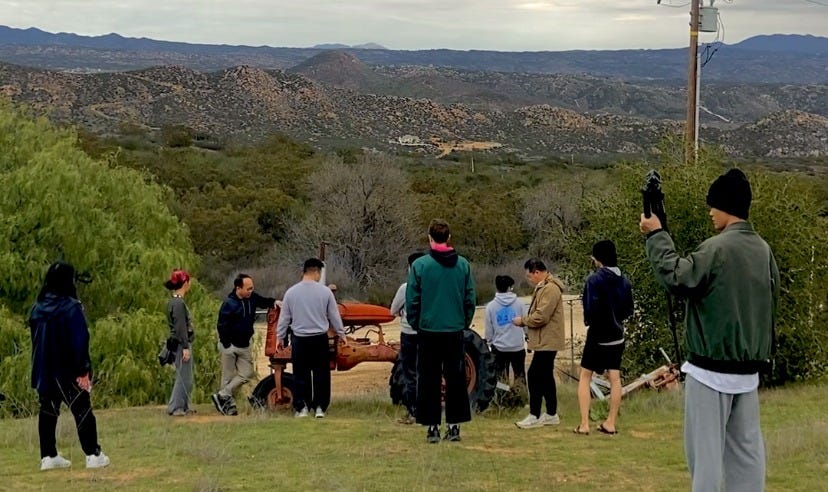
I welcomed the turning of the new year in the place that once held me (my birthplace, my childhood neighborhood, these streets of my teenagedom) and was held.4 I over-ate the way I did in high school; I dug a few holes in the backyard; I sang hymns in Vietnamese; I learned the difference between pelicans and cranes and storks; I shed a few tears because a dog I loved had died; I played Bananagrams and Overcooked and Super Smash with my cousins.
such an offer
such a communion
must be taken
as holy
, Bukowski writes in that beautiful poem of his, “butterflies.” In the past week, I’ve driven by my high school, newly reconstructed, barely recognizable to me now; and I’ve lain on the grassy field of my elementary and middle school, which was also the backyard of the church I grew up attending. There are ghosts of a little Kaitlan walking those grounds, and each time I return they greet me.
At the turn of the new year, I woke up thinking of a word, or rather, a prefix: “Re-.” No new year’s resolutions, no bingo cards; just this fragment of a word I am beholding.
return
relax
repeat
reciprocate
reinspire
reinvoke
remember
render
regenerate
rest
There is a newness, a tenderness, about the things I once considered old, even wretched, even shameful. There is forgiveness, recalibration, reintegration, a softer window of kindness and return. Recently, I found my middle school glasses tucked away in a cardboard box at the back of my shelf. I put them back on, these glasses that I once despised—glasses that once made me feel so ashamed of myself. They were not too small for me. They were not stupid or painful. They were, in fact, quite chic and cool; and at the same time they represented a side of myself that I had hated and repressed as a child.
Back in middle school, these glasses had fallen under the budgetary restriction of my parents’ insurance plan. They were the only ones we could afford. So I felt poor and nerdy whenever I wore them, and to make matters worse my middle school crush made fun of me the first day I dared to wear them in class (mostly out of flirtation, but the insecurity stuck). Needless to say, I chose to squint most of my way through middle school.
Now at 25, out of curiosity for the past and in the name of silly reenactment, I donned those awful plastic bifocals once more. Somehow, almost magically, they were not the bad and monstrous thing I had always remembered them to be; they fit like Cinderella’s slipper; they corrected my vision perfectly; and as soon as I put them on, the person I’d fallen in love with in adulthood kissed me and gushed over them; I love them; I love them; I love you, he said—the tilt of the world felt somehow forgiven, everything aligned, everything accepted and acceptable.
That is how this new year feels, and I don’t want to be alone in that feeling. I want to draw everyone I love together, closer and closer each day unto the next. I recently fell upon Audre Lorde’s “A Burst of Light” again, which feels to me like an invocation for the new year:
A better question is—how do I want to live the rest of my life and what am I going to do to ensure that I get to do it exactly or as close as possible to how I want that living to be? I want to live the rest of my life, however long or short, with as much sweetness as I can decently manage, loving all the people I love, and doing as much as I can of the work I still have to do.
Yesterday, I dreamt I was back in high school. Then I woke up this morning and thought of butterflies. And not too long after that, I wrote this letter to you.
Love,
Kaitlan
“butterflies” by Charles Bukowski
“What the Living Do” by Marie Howe
“I wonder if I will miss the moss” by Jane Mead