

if trees could tell
on love, as always

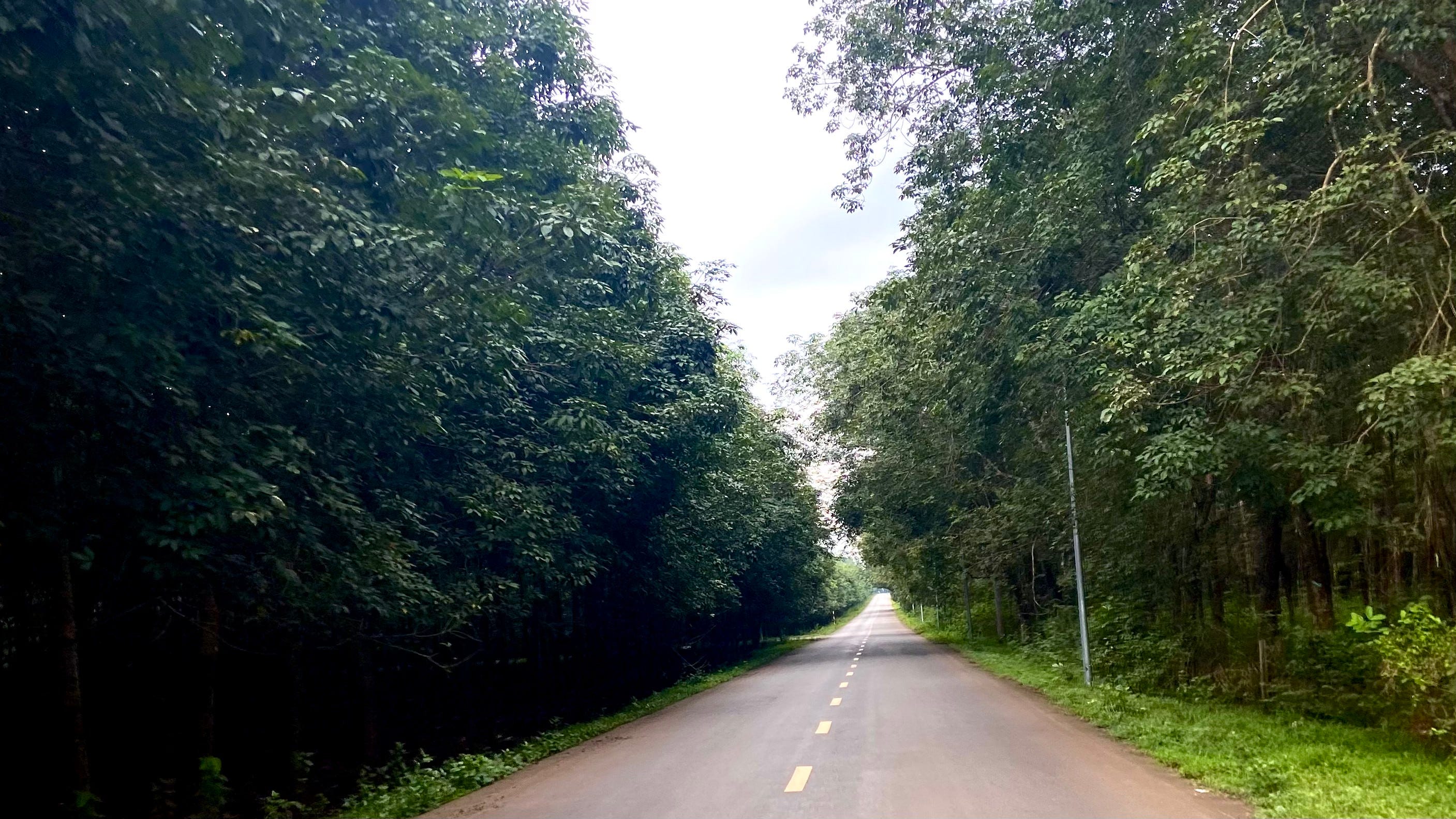
It is October and there are no trees to tell of it. There are trees here, of course—papaya trees and jackfruit trees and cao su trees peppering the road to my friend’s house, their skinny trunks now black from harvesting—but none of them tell me the story of fall.
I suppose this is because fall has never come to Vietnam, and it never will. The streets are the same kind of hot and sticky as they were when I arrived—we call it wet season, and after this season, a dry one.
But there is fall where you are. It is in the sky, and in the coffee, and in the new selection of Costco decorations. I think of you every day, and because I think of you every day, my brain ticks in time zones. So maybe it’s not too far off to say that fall has come to me too.
I wish we could walk together under the red-orange trees. I wish we could turn to each other and say, “Oh, just look at that sun.” And then that sun would set an hour too early, and the wind would feel a degree too cold, and maybe that once-a-year loneliness would begin creeping into our hearts.
But anyways, I am in Vietnam right now. I am standing on the edge of my run-down terrace. I am feeling the fat raindrops slide off my fingertips, and I’m thinking to myself, I can do this. I can love this. I love this. And I do.
But I still want you to know I miss everything. Fall, I mean. And you.
There is always so much to tell you. How does one begin to tell, anyway? Maybe with a bicycle. Or rice. Or a fish. Have you ever caught a fish?
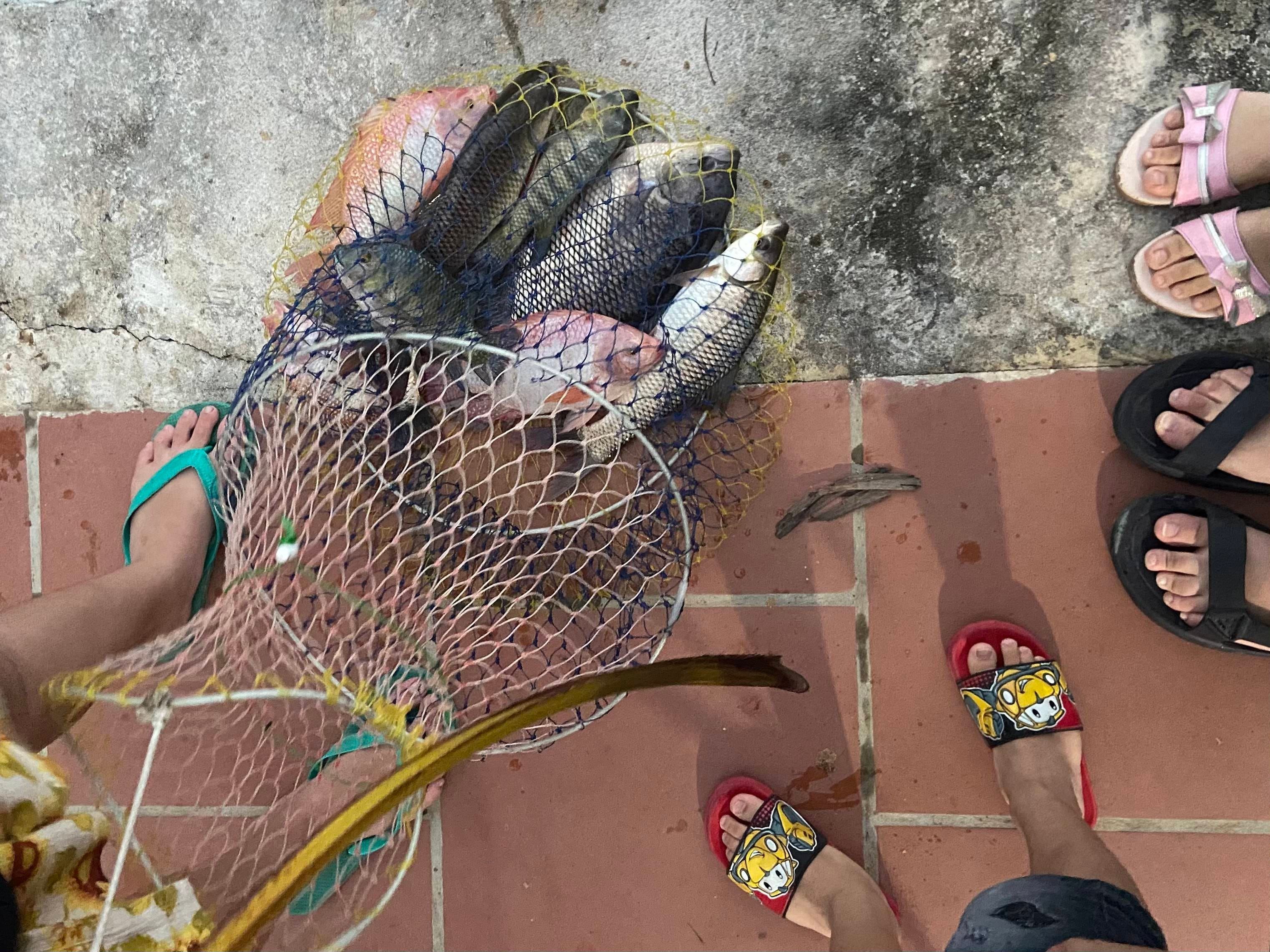
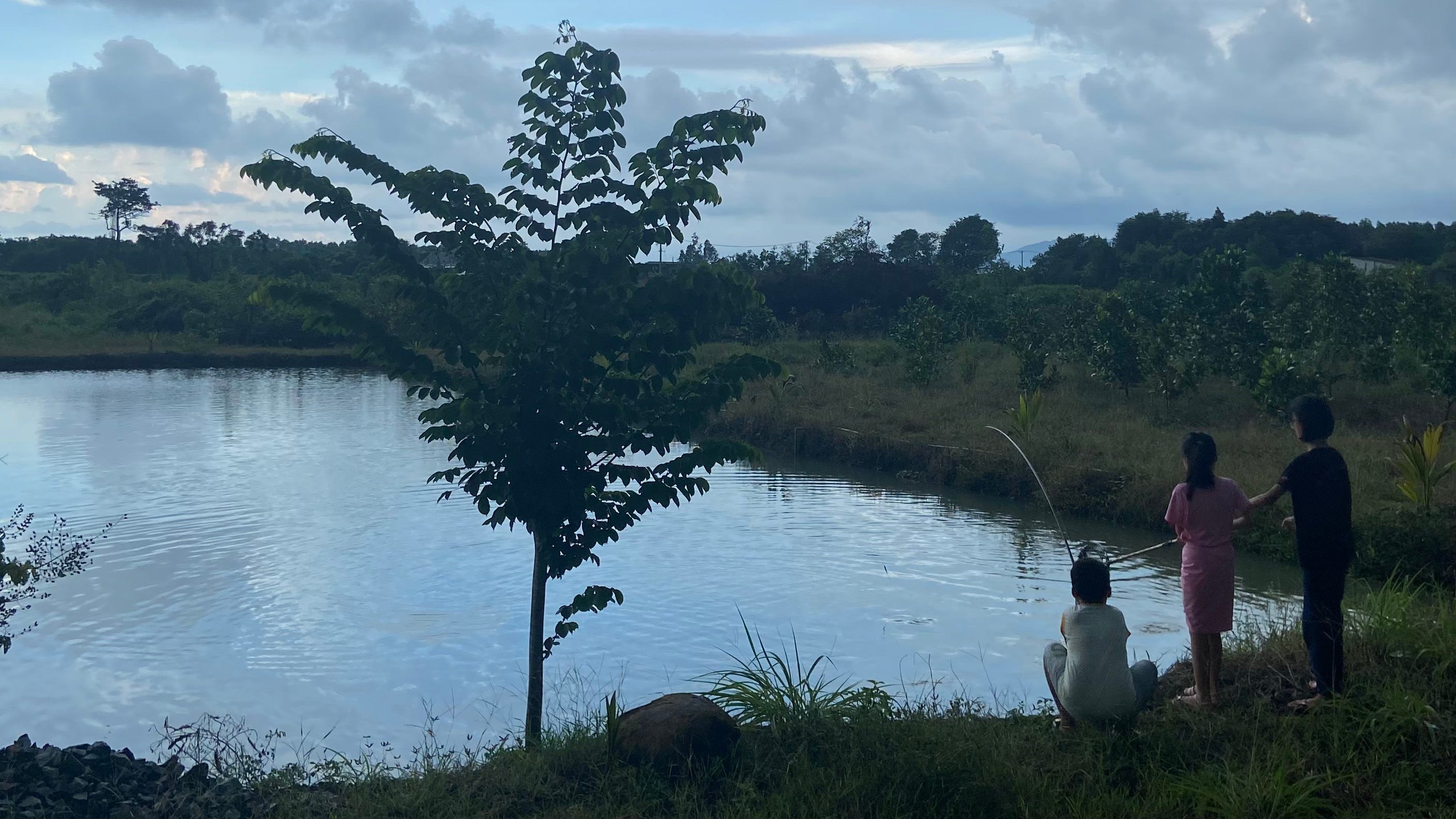
I have, but only one, and just three weeks ago. Three weeks ago, I visited the countryside with a kind group of families. They asked if I wanted to try fishing, and when I said I did, they gave me a fishing rod, and I cast it into the water. After a couple of minutes, I felt a tug, and there he dangled—that precious silver fish. I reeled him in, and a little boy helped me unhook him.
That was when the fish jumped. He jumped again, and then again, and we screamed. That was when the fish fell back into the pond.
So the first fish I caught was never really caught, and for a while this fact disappointed me. But when I thought about it later, I was glad I didn’t have to exchange my victory for a life.
Over the past two months, I have exchanged so little for so much. Two dollars for lunch. Three hours for coffee. Coffee for a conversation, and conversation for the closest friends I have made in Vietnam. I’ve bought áo dài from a friend of a friend, visited an orphanage, become a regular at the rice place across the street. And every day I order something in Vietnamese. Every day my pockets are Pepto-Bismol-free. I suppose it’s a good thing the cells lining my stomach have regenerated—it saves me the bathroom troubles—but now I worry all the other parts of me are regenerating too. I don’t want to dissolve into something else. I want you to remember me the next time you hold me. I want myself to feel familiar. I want you to know it’s still me.
For the entire month of September, I found myself perpetually on the verge of tears. In those moments, I yearned for fall the most. I think I wanted a season to be safely sad inside, like a house or a bed or a worn-out sweater. I watched Little Women and cried. I called my mom and cried. It rained and I cried, and then it didn’t rain and I cried.
I taught my first several classes, which was hard, and I spent an entire weekend speaking only Vietnamese, which was hard too. But it is hard and good. I ate bánh khọt, and mì cay, and the best takoyaki the world has known. I will eat them all again, and then some, I’m sure.
I am riding on the back of a thousand different motorbikes.
I am learning how to sleep early and wake with the sun.
Every day, I take a deep breath, and I open my little door, and I walk out.
It is all very hard and very good.
And I am getting better at it every day.
Really. You wouldn’t believe how good I am getting.
Bà Rịa, my home for the past month—and the next eight—is a quiet city. The most common establishments here are cafes, pharmacies, and English centers. I am one foreigner in a mix of very few. Everyone else here seems to know everyone else.
There was this one time I went to buy sanitary pads at the general store next door. When the shopkeeper rang up my items, she asked me if I was new around town.
“I don’t think I’ve met you before,” she said, and I told her that she was right, I was new here, and I was teaching English at the Cao Đẳng Sư Phạm. “For a year,” I said, and then she said back, “Have you met my brother Hảo?”
“Oh my gosh, Anh Hảo? He helped me with the sound system yesterday.”
“Right, that’s him. Hảo.”
“No way!”
“That’s right.”
Before I left the store, the shopkeeper asked me if I wanted to go to Saigon with her and Anh Hảo that weekend. “There’s space in the car,” she shrugged, but I told her thank you, I’m so sorry, but I cannot. I had already been invited to a family memorial service that weekend.
That weekend, at that family memorial service, I would meet the fiance of the nephew of someone I knew, and she would invite me to her wedding. And we would sit on red plastic chairs, and she would tell me, “You know, after I get married, I’ll live in Boston for a long time.”
“Oh my gosh, Boston? That’s in Massachusetts—that’s near my college.”
“Right, that’s it. Boston.”
“No way!”
“That’s right.”
And I would think to myself, what a strange, small, lovely world.
From 11 a.m. to 2 p.m., the gates to my dormitory are closed. In fact, most everything is closed: the school office, the gym I frequent, that one milk tea stand I have yet to try. There was this one time I went lunch-hunting past noon and could not find an open restaurant. They were all sold out, or sleeping, or sorry-you’re-too-late.
“It reminds me of Portugal,” a friend told me.
“It reminds me of Spain,” another friend said.
“But I wish it was more like the United States,” a student sighed during office hours. “I like that Americans have calendars with lots of colors. I like that people are really busy.” We talked about hustle culture, and I remembered how just a year ago, I was averaging five hours of sleep a night. I told her about my favorite dining hall, which closes at 2 a.m. So then I thought about burgers and 24-hour libraries and, of course, you.
“Do you get bored at night here?” another student asked me. “In Bà Rịa, it’s so boring at night. Unlike Ho Chi Minh City or Hanoi or New York.”
But I said I didn’t know. I did miss the burgers and the 24-hour libraries. And I missed you too, but still I said, “I kind of like it. I get to have some time to myself. I’ve never really wanted that before.” I’ve also never had it before, I realized.
So anyways, I am learning how to be quiet.
I am learning how to be with myself.
I am riding a little aluminum bicycle next to a sea of cars and motorbikes—and when the light turns green, I am pedaling hard, left in a haze of smoke with cramping calves and another hundred meters to go.
The trees on the way to my friend’s house give my heart the most incredible peace. I am sitting on the back of her xe máy, and we are talking about our secrets and our grudges and how cashew and cao su sound so similar.
As the wind whips past us, I look into the grove and breathe deeply. If I can just remember this smell, maybe I’ll remember this moment forever. I open my eyes again. It is green, and green, and green for miles. It makes me miss fall, and when I miss fall I think of you.
“Such things as these cherished tears / coloring / the scattered red leaves,” Basho writes. I wish these leaves were red.
I think about the essay I wrote a year ago, and what it means to have a season (and a darkness) to cast all our sadnesses upon. Let me see orange. Let me see red and yellow and brown. Let me taste badly salted butternut squash from a dining hall, please. It is October but there are no trees to tell of it, and how can one be sad when the trees are so green?
When it is hard to open my door, when I wake up and automatically do the time calculations, and when I hear Jo March cry on my computer screen, “But—I am so lonely,” I just want fall to fall upon me.
Look, the trees
are turning
their own bodies
into pillars

of light,
are giving off the rich
fragrance of cinnamon
and fulfillment

the long tapers
of cattails
are bursting and floating away over
the blue shoulders

of the ponds,
and every pond,
no matter what its
name is, is

nameless now.
Every year
everything
I have ever learned

in my lifetime
leads back to this: the fires
and the black river of loss
whose other side

is salvation,
whose meaning
none of us will ever know.
To live in this world

you must be able
to do three things:
to love what is mortal;
to hold it

against your bones knowing
your own life depends on it;
and, when the time comes to let it go,
to let it go.
— “In Blackwater Woods” by Mary Oliver
Here is what I mean.
No matter where I ended up this year—California, Providence, Greece, Vietnam—I would be writing about the same things. Every year, it is the same series of questions. Do you love me? Do I love you? How can we know?
Can I do this? Can I hold this? Can I keep it forever?
It always comes back to this longing.
Sure, I have traveled eight thousand miles. Sure, I have lived sixty days in a foreign country. But what I mean is that anywhere, at any time, even if I were you and you were me, I think I would be writing these words.
In Vietnam, I have encountered an infinite array of stories and people: a grandmother who smokes cigars late into the night, waiting to greet her granddaughter’s boyfriend; a baby nicknamed after his mother’s greatest dream—deferred because she must raise him instead; a young woman who cannot drink coffee, yet who helps her mother each day with their family coffee business.
I think to myself, what a strange, small, lovely world. I think to myself about how all of us, every way, every day, across time zones and life stages—all of us have the same underbelly to our story, and the same plea to each other: love me, love me, love me.
I know it’s old, this love talk. I’m sorry to write about it again, but really I’m not sorry at all.
I am sad. I am happy. You should know I am doing well, but also sometimes it is hard to get out of bed. Also, I miss you, though not enough to fly back.
I am figuring things out here. I still need time. It’s okay if you do too.
Finally, and here’s the most important part: I love you.
It’s how every good letter ends. I’m sure you know those words by heart, but I think I should say them anyway and then repeat for good measure. So here it is again:
I love you.
I love you.
I love you even more than trees can tell, and now I’m learning to love myself.
Dear Kaitlan, What an extraordinary series of prose-poems you have shared with all of us who are, as I peck out these words, enjoying the onset of fall. Your eloquence, the poetic gestures, and the extraordinary eye you have for the telling detail are extraordinary. And thank you, too, for sharing the Mary Oliver poem, which I had not known before but which I will now keep as a treasure along with your own jewels. I am only Gus' dad, but sending you love nevertheless from across the time zones. Be well and continue to be you.
I love you too Kaitlan. You are dearly missed.